

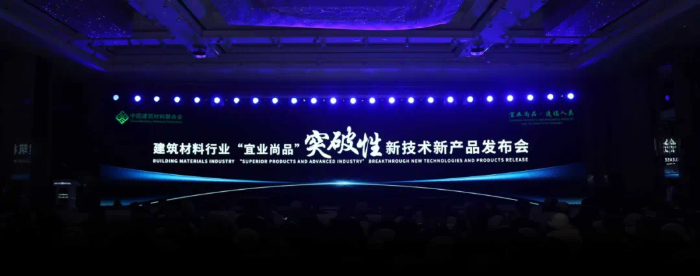
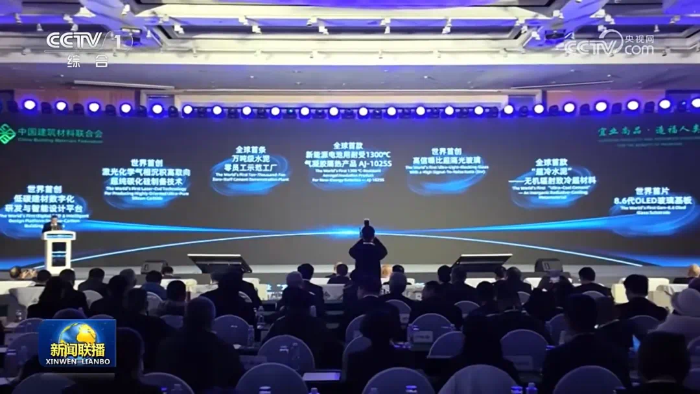
On December 3, as an important component of the 2025 Building Materials Industry Conference and the Industry Science and Technology Innovation Conference, the Second “Superior Products and Advanced Industry” Breakthrough Technology and New Product Release Conference of the Building Materials Industry was held. At the event, seven “world-first” and “globally leading” breakthrough achievements in the building materials industry were unveiled. This year, the release conference introduced a live-streaming format for the first time, presenting in real time the remarkable achievements made in major scientific and technological research under the “open competition for the best candidates” mechanism, the construction of “Six-Zero” factories, and the development of new inorganic non-metallic “super materials.”
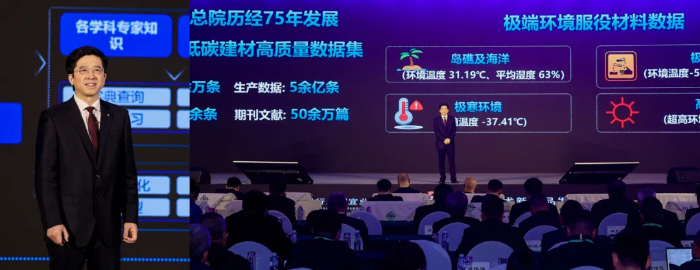
Zhi Xiao, Chairman of China Building Materials Academy Co., Ltd., on behalf of the company, released the world’s first Low-Carbon Building Materials Digital R&D and Intelligent Design Platform. The platform responds to the urgent need for digital transformation in the R&D of inorganic non-metallic materials, establishing a full-process intelligent R&D system that integrates a high-quality materials database, an intelligent laboratory, and an R&D large model. It breaks through traditional R&D bottlenecks for inorganic non-metallic materials, achieving 90% automation in intelligent experiments and more than 90% accuracy in property prediction by the R&D model, thereby building a new paradigm of digital R&D for inorganic non-metallic materials—from data-driven insights to intelligent decision-making.
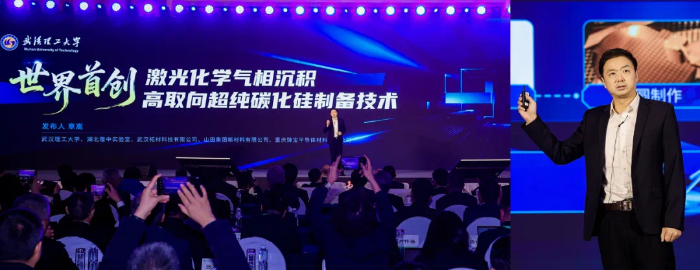
Professor Zhang Song of Wuhan University of Technology, on behalf of the team, released the world’s first Laser Chemical Vapor Deposition (CVD) High-Orientation Ultra-Pure Silicon Carbide Preparation Technology. This technology overturns the passive Joule heating mode in traditional CVD and realizes active heat transfer, rapid heating, and photothermal synergy, overcoming key bottlenecks in the efficient preparation of highly oriented, ultra-pure silicon carbide materials. It improves efficiency by 3–10 times, increases yield by 2–3 times, and reduces costs by 50%–90%, greatly advancing the domestication of equipment and critical components for integrated circuit chips and related fields.
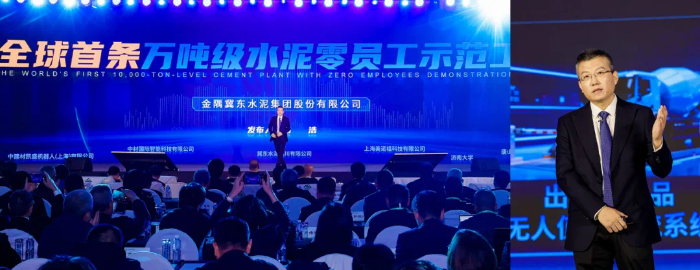
Feng Hao, General Manager of Jidong Cement Tongchuan Co., Ltd., on behalf of the company and its team, released the world’s first 10,000-ton Cement “Zero-Employee” Demonstration Plant. The plant establishes a three-dimensional sensing system for cement production parameters, develops data models and algorithm libraries for key links and core areas of “AI + Cement Manufacturing,” and creates unmanned systems for pulverized coal detection and cement retention sampling. It proposes and validates a “digital-intelligence-driven” method for constructing zero-employee digital cement plants, providing a mature and replicable solution for the digital and intelligent transformation of the cement industry.
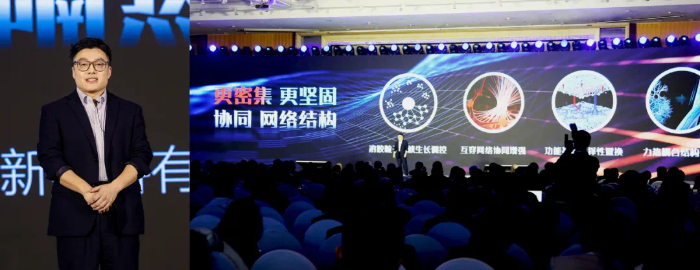
Teng Kaiming, General Manager of Jiangsu Jiayun New Materials Co., Ltd., on behalf of the company, released the world’s first Aerogel Insulation Product for New Energy Batteries Capable of Withstanding 1300°C. This product is the world’s first silicon-based aerogel that withstands 1300°C and features high-temperature resistance, thermal insulation, and superhydrophobic properties. It has achieved large-scale production and application. It effectively blocks heat transfer to adjacent battery cells and maintains stable performance under extreme conditions, requiring only one-third to one-half the thickness of conventional aerogels.
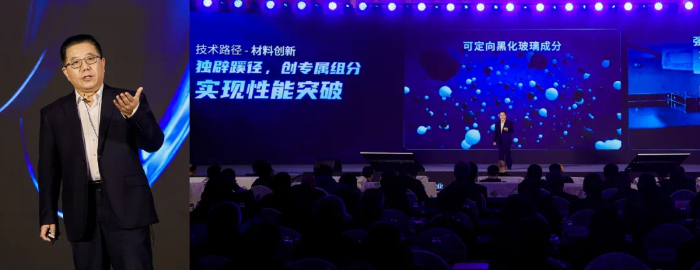
Jia Jinsheng, Deputy General Manager of China Building Materials Academy Co., Ltd., on behalf of its subsidiary CNBM Photonics Technology Co., Ltd., released the world’s first High Signal-to-Noise Ratio Ultra-Light-Blocking Glass. This product significantly enhances light-blocking efficiency and reduces interfacial reflectance through unique light-blocking technology, thereby improving signal-to-noise ratio and reducing power consumption. It addresses key challenges faced by optical sensors in high-tech fields—such as inaccurate measurement, poor visibility, and high energy consumption—ensuring that devices receive pure and accurate signals. The product has already been applied in leading-brand smartwatches, significantly improving standby time.
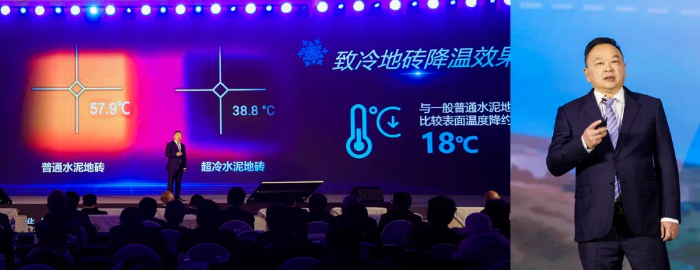
Wu Feilong, Technical Director of Jiangxi Yinshan Supermaterial Technology Co., Ltd., released the world’s first “Ultra-Cold Cement” — an Inorganic Radiative-Cooling Metamaterial. This product overturns conventional perceptions of cement and provides a brand-new inorganic cementitious material for radiative cooling, upgrading cement from a traditional structural material to a multifunctional supermaterial. It achieves 96.2% solar reflectance and 96% atmospheric-window emissivity. Under midday solar irradiance of 850 W/m², an ultra-cold cement panel registers 5.4°C lower than ambient temperature. It also features high strength exceeding 52.5 MPa and has already achieved industrial production.
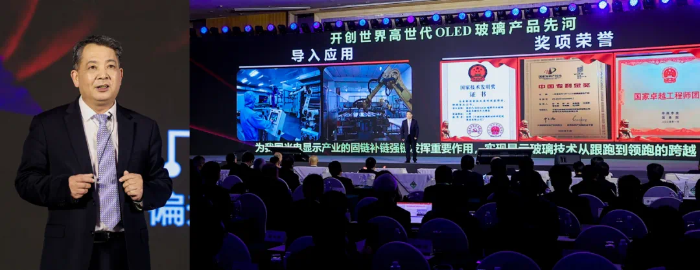
Zhang Chong, Chief Expert of CNBM Glass New Materials Research Institute Co., Ltd., on behalf of the company and its team, released the world’s first Generation 8.6 OLED Glass Substrate. Utilizing an original “precious-metal channel ultra-thin float” process route, the team developed a key manufacturing technology for Gen 8.6 OLED display glass with fully independent intellectual property rights. This achievement marks the world’s first industrial production of high-generation OLED ultra-thin float glass substrates and fills the technological gap in the Gen 8.6 OLED glass substrate segment of the optoelectronic display industry chain.
Editor: Zhang Hanwen
Reviewer: Shen Yulu, Li Yuemei