

On December 3, the 2025 Building Materials Industry Conference was convened in Ningbo, Zhejiang, under the theme of “Innovation-Driven, Green-Led: Promoting High-Quality Development to Transform the Building Materials Industrial System.” This conference was held at a critical moment—marking the conclusion of the 14th Five-Year Plan and the planning stage for the 15th Five-Year Plan, as well as at an important juncture in which the building materials industry is expected to achieve carbon peaking in 2025 and move fully toward the carbon-neutral era. The conference systematically summarized the achievements of the building materials industry during the 14th Five-Year Plan period and set forth goals for advancing green, low-carbon, safe, high-quality development and building a modern industrial system.
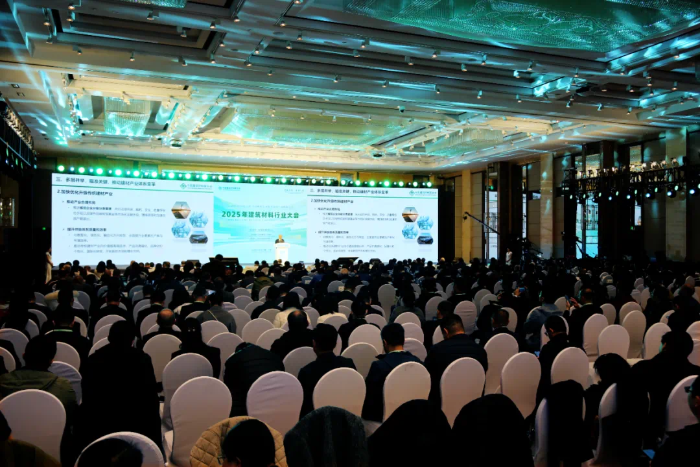
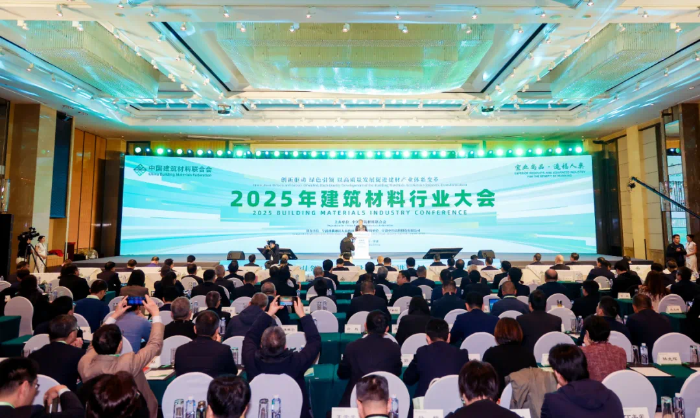
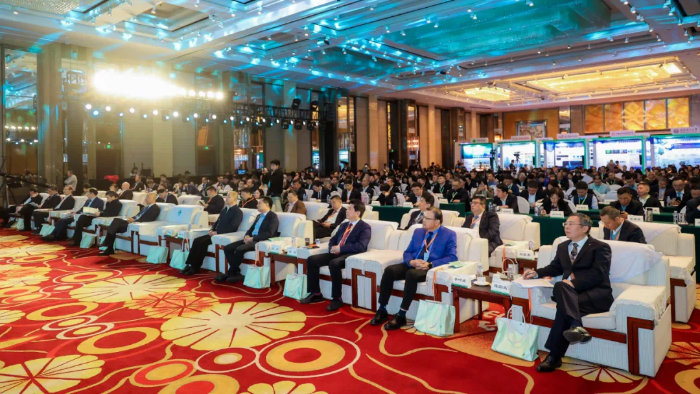
Li Xiaolong, Chief Engineer of the Ministry of Housing and Urban-Rural Development (MOHURD), attended the conference and delivered remarks; Wang Chunyuan, Deputy Director-General of the Raw Materials Industry Department of the Ministry of Industry and Information Technology (MIIT), delivered a speech; Yan Xiaofeng, Secretary of the Party Committee and President of the China Building Materials Federation (CBMF), delivered the keynote report; Chen Xingli, District Mayor of Yinzhou District of Ningbo, delivered a speech; Zhang Jie, Vice Chairman of the China Machinery, Metallurgy and Building Materials Workers’ Union; Bai Zhengsheng, Level-1 Inspector of the Standards and Quotas Department of MOHURD, and Zhang Feng, Chief Engineer of the Center for Science and Technology and Industrialization Development, also attended.
CBMF Executive Vice Presidents Yang Jun (Chairman of Anhui Conch Group), Wang Gang (Chairman of Jinjing Group), and Li Yeqing (President of Huaxin Cement); CBMF Vice President and Academician of the Chinese Academy of Engineering Peng Shou, Academicians Xie Jianxin, Zhang Lianmeng, Dong Shaoming, Liu Jiaping, and Shi Caijun; CBMF resident and non-resident vice presidents and deputy supervisors; Wang Fazhou, President of Wuhan University of Technology; CBMF executive directors, directors, member units, as well as leaders and representatives of related industry associations, provincial and municipal associations, key enterprises, research institutes, universities, and CBMF-affiliated units—more than 600 participants in total—attended the conference. The meeting was chaired by Chen Guoqing, Deputy Secretary of the CBMF Party Committee and Executive Vice President.
The conference was hosted by the China Building Materials Federation and strongly supported by the People’s Government of Yinzhou District, Ningbo, and Ningbo Zhongzhun High-tech Co., Ltd. CCTV News and the CCTV News Channel provided multi-angle coverage on the same day. The conference also received wide attention and reporting from major media outlets including People’s Daily, Economic Daily, Science and Technology Daily, People.cn, CCTV.com, China Securities Journal, Economic Information Daily, China Industry News, China Environment News, China Quality Daily, China Financial and Economic News, and China Building Materials Magazine.
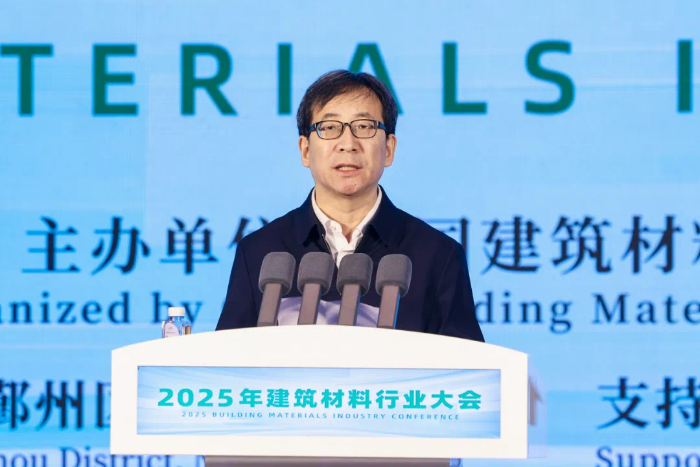
Li Xiaolong, Chief Engineer of MOHURD, delivering remarks at the 2025 Building Materials Industry Conference
Li Xiaolong emphasized that the building materials industry is closely linked with the construction industry and plays an important role in promoting urban and rural development, improving living environments, and serving national strategies. The value of the building materials industry is reflected in every key link of housing and urban-rural construction, and the future outlook remains promising.
He noted that the industry must adapt to the new stage of urban development and further achieve high-quality development. The Central Urban Work Conference pointed out that China’s urbanization is shifting from a period of rapid growth to a stage of stable development, and that urban development is transitioning from large-scale expansion to improving the quality and efficiency of existing stock. These “two shifts” indicate fundamental changes in the mode of urban development—and consequently, fundamental changes in the development logic of the building materials industry. Demand has evolved from “availability” to “quality.” Whether urban renewal, low-carbon transformation, or “Good Houses,” all must adhere to a people-centered approach, break away from traditional paths, and rely on innovation to achieve qualitative improvement and reasonable quantitative growth.
He called for focusing on technological innovation to strengthen the core foundation for industrial upgrading; focusing on low-carbon transformation to solidify green development; and focusing on raising standards to remove critical obstacles to high-quality development.
He stressed the need to deepen coordination and build a new pattern of integrated development between the building materials and construction industries. Construction continues to guide innovation in building materials, while breakthroughs in building materials support construction quality and efficiency improvements. Promoting deep integration between the two industries is required by the new stage of urban development. He called for strengthening supply-demand alignment, establishing communication and feedback mechanisms around urban renewal, green construction, renovation of existing buildings, and urban lifeline infrastructure. Construction must promptly feedback material application needs, while the building materials industry should develop precise and compatible products—forming a mutually reinforcing cycle of “demand driving R&D, and R&D supporting application.”
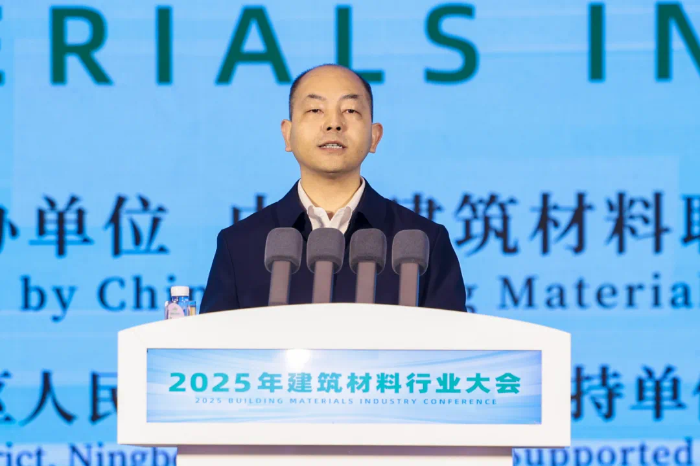
Wang Chunyuan, Deputy Director-General of MIIT's Raw Materials Industry Department, delivering remarks
Wang Chunyuan stated that deepening reform is essential to promoting high-quality development of the building materials industry. Facing current realities and challenges, innovation must be embedded throughout the entire process. During the 15th Five-Year Plan period, four key capabilities must be elevated to take solid steps toward building a modern building materials industrial system:Enhancing technological innovation capabilities—continuously advancing key technologies, accelerating the application of scientific achievements, strengthening weak links, and promoting enterprise innovation through mechanisms such as “open competition for the best candidates” and “horse-race mechanisms,” thereby fostering industrial clusters with advantages in non-metallic mineral resources.Improving high-quality product supply—continuing “Green Building Materials to the Countryside,” encouraging localities to organize “small but beautiful” activities, carrying out “Good Materials for Good Houses,” strengthening alignment with capacity standards, and expanding applications of high-quality materials. Enhancing advanced manufacturing capabilities—supporting enterprises in implementing cleaner production upgrades, building intelligent and green R&D facilities, and leveraging the role of the Building Materials Digital Transformation Promotion Center. Strengthening enterprises’ integrated development capabilities—encouraging large enterprises to align with national strategies and industry needs, optimize and integrate industrial, innovation, and value chains, and enhance product value, profitability, branding, and global competitiveness.
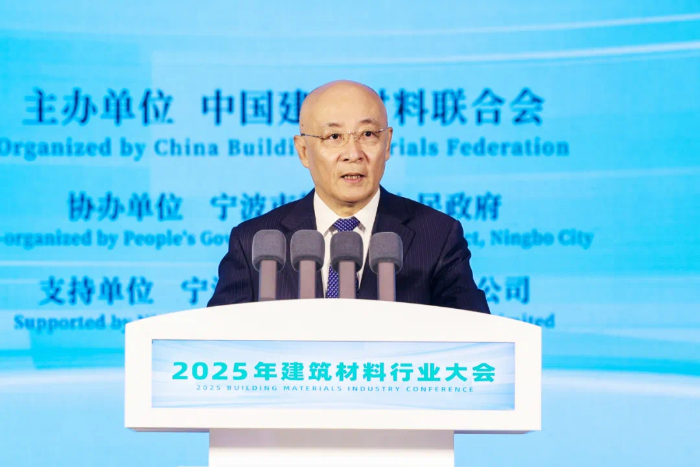
Yan Xiaofeng, President of CBMF, delivering the keynote report
Yan Xiaofeng noted that during the 14th Five-Year Plan period, China’s building materials industry achieved a series of new breakthroughs in industrial structure and green, low-carbon development. The industry maintained steady progress beyond expectations, with industrial added value growing at an average annual rate of 0.5%; the number of above-designated-size enterprises increased by 36.9%, and total assets grew by 54.2%. In terms of structural optimization, the “new trio” of building materials—green building materials, photovoltaic glass, and fiberglass composites—emerged as new engines of high-quality development. Revenue from green building materials exceeded RMB 205 billion, with an average annual growth rate of 20%.
Green and low-carbon transformation also achieved remarkable results: industry CO₂ emissions have fallen for four consecutive years, with a cumulative decline of 20.4%. Compared with the 14th Five-Year Plan baseline, by 2025, CO₂ emissions from the building materials industry are expected to decline by 24.9%, energy consumption per RMB 10,000 of added value to decline by 17.4%, and CO₂ emissions per RMB 10,000 of added value to decline by 25.3%.
Digital transformation is accelerating, with “AI + Building Materials” emerging as a new direction; in 2024, the CNC rate of key processes reached 66.5%, signaling rapid progress in intelligent transformation.
He emphasized that the industry faces profound changes in both internal and external environments. Externally, declining traditional demand and strict carbon constraints pose major challenges; internally, structural contradictions and declining profitability require urgent solutions. In the long term, however, the fundamentals supporting the industry’s steady growth remain unchanged. Facing these changes, the industry must adopt a global perspective, promote industrial system transformation, and open new development pathways—shifting from scale-focused to quality-focused development.
He elaborated on the pathways for high-quality development to comprehensively promote industrial system transformation, proposing the “Four All-Out Efforts”:
– All-out efforts to build a new industrial development model;
– All-out efforts to meet the new requirements of the carbon-neutral era;
– All-out efforts to drive innovation and cultivate new productive forces;
– All-out efforts to raise the level of international development.
He further put forward the “Nine Accelerations” for guiding high-quality development:
accelerating the establishment of quality evaluation systems; upgrading traditional industries; cultivating new inorganic non-metallic materials; enhancing non-metallic mineral resources; advancing “Six-Zero” factory creation; expanding carbon-neutral actions; improving digital and intelligent capability; promoting “Good Materials for Good Houses”; and deepening internationalization.
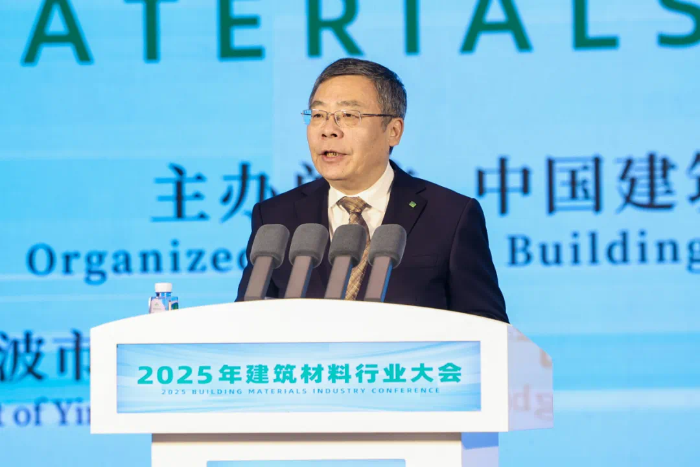
Chen Guoqing, Deputy Secretary of the CBMF Party Committee and Executive Vice President, presiding over the meeting
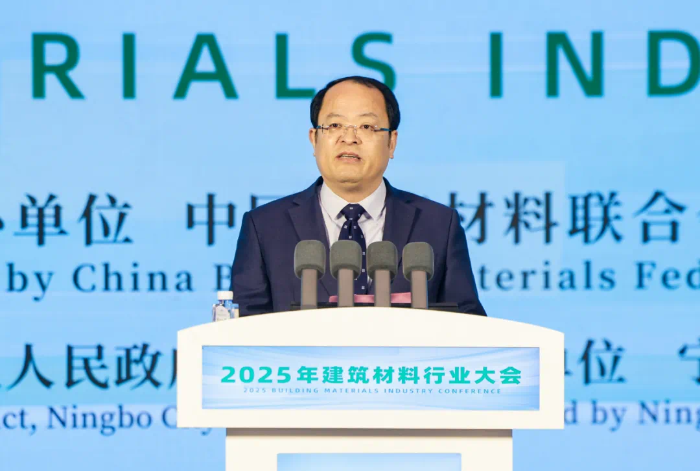
Chen Xingli, District Mayor of Yinzhou District, Ningbo, delivering remarks
Chen Xingli stated that Yinzhou District has formulated local guidelines for “Good Houses” and has fostered three key innovation clusters—digital intelligence technology, energy technology, and building materials technology—providing strong momentum for industrial upgrading.
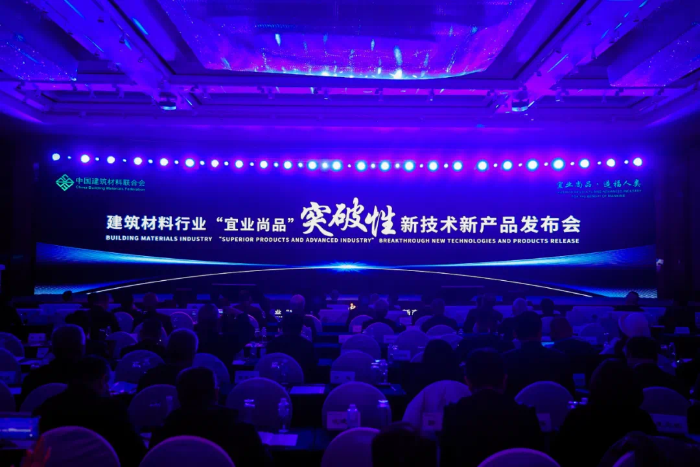
Release of Breakthrough New Technologies and Products of the Building Materials Industry (“Superior Products and Advanced Industry”)
The second release event for breakthrough technologies and products in the building materials industry expanded upon last year’s success, introducing a live-streaming format for the first time. Nearly 160,000 viewers watched the live broadcast.
Following public solicitation and expert selection, seven world-first technologies and products were released, including:
– the world’s first low-carbon building materials digital R&D and intelligent design platform;
– the world’s first laser CVD high-orientation ultra-pure silicon carbide technology;
– the world’s first 10,000-ton “zero-employee” cement demo plant;
– the world’s first 1300°C aerogel insulation product for new-energy batteries;
– the world’s first high signal-to-noise ultra-light-blocking glass;
– the world’s first “ultra-cold cement,” an inorganic radiative-cooling metamaterial;
– and the world’s first Gen-8.6 OLED glass substrate.
These achievements reflect major technological breakthroughs made through the “open competition for the best candidates,” the creation of “Six-Zero” factories, and the development of new inorganic non-metallic “super materials”—and demonstrate the broad prospects of future building materials applications.
The conference also released a series of authoritative industry reports and achievements, including:
– the China Building Materials Industry Carbon Emission Report (2025);
– the 2026 Building Materials Industry Prosperity Index (MPI);
– the 2025 Global Top 100 Listed Building Materials Companies Comprehensive Strength Ranking;
– typical application cases of CBMF group standards recognized by MIIT in 2024;
– the achievements of the 3rd Industrial Design Innovation Competition;
– the results of the 1st AI Innovation Application Competition for the Building Materials Industry;
– and China’s first General Guidelines for Good Materials Selection standard.
The conference also showcased the cultural soft power of the industry, including outstanding performances from the “2025 Building Materials Spring Festival Gala.”
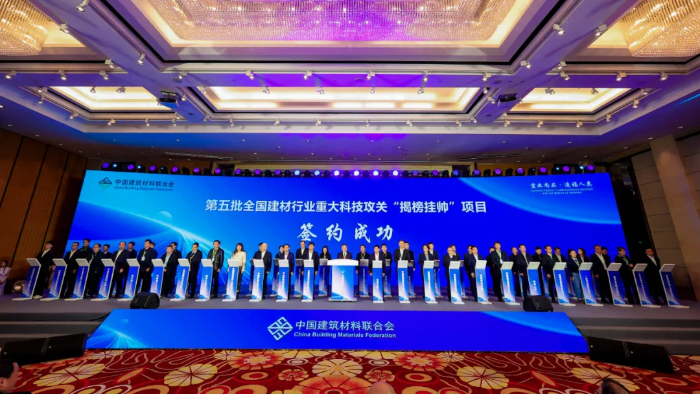
On the afternoon of December 3, the Building Materials Industry Science and Technology Innovation Conference was held concurrently. During the event, 49 teams undertaking the 5th batch of national major science and technology projects under the “open competition for the best candidates” mechanism completed contract signing, and 69 award-winning projects of the 2024 Building Materials Science and Technology Award were recognized.
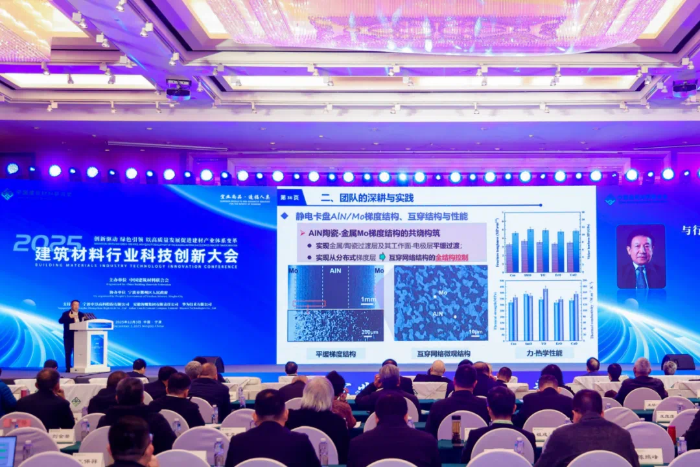
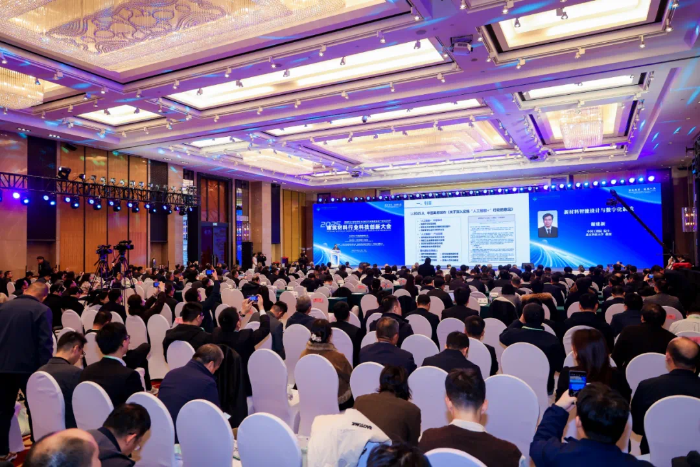
The signature event of the Science and Technology Innovation Conference—the Building Materials Science and Technology Forum—featured Academicians Zhang Lianmeng, Xie Jianxin, and other distinguished speakers. They shared insights on semiconductor-related industries, smart design of new materials, and digital transformation, bringing participants a grand intellectual feast and showcasing the vitality of innovation in the building materials sector.
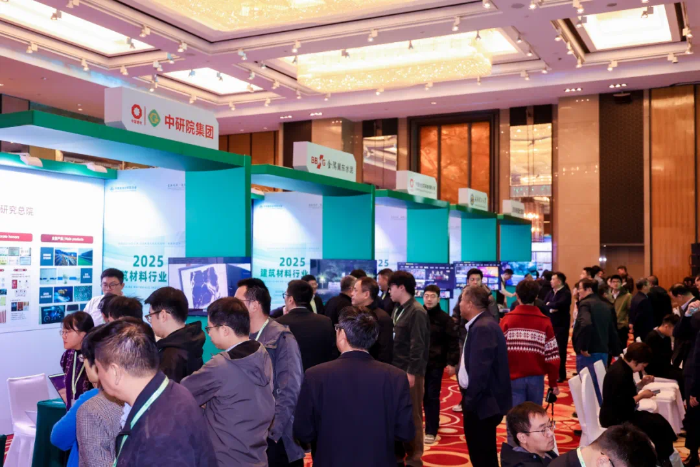
In addition, experts from enterprises, universities, and research institutes conducted thematic exchanges on frontier technologies and key issues. The exhibition area featuring new technologies, new products, new equipment, and new applications also became a major highlight, attracting significant attention and engagement from participants.
Editor: Zhang Hanwen
Reviewer: Shen Yulu, Li Yuemei